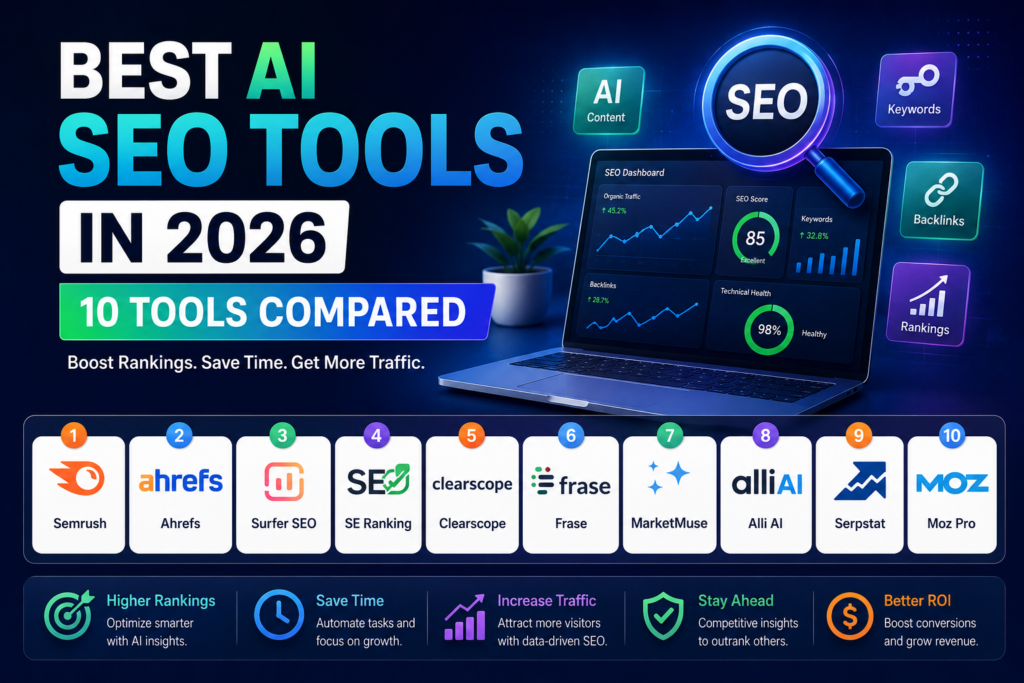
The best AI SEO tools in 2026 can help businesses, marketers, bloggers, and agencies improve search visibility, optimize content, research keywords, analyze competitors, and save time on repetitive SEO tasks.
AI is changing the way businesses, marketers, bloggers, and agencies approach search engine optimization. Modern AI SEO tools can help with keyword research, content optimization, competitor analysis, technical SEO, rank tracking, and visibility across traditional search and AI-powered search.
But not every AI SEO platform is designed for the same job. Some focus on SEO data and competitor research, while others specialize in content optimization, keyword planning, technical audits, or automated website workflows.
In this guide, we compare the best AI SEO tools in 2026 based on features, use cases, ease of use, pricing approach, and the type of SEO user each platform is best suited for.
Best AI SEO Tools in 2026: Quick Comparison
| AI SEO Tool | Best For | Key Strength |
|---|---|---|
| Semrush | All-in-one SEO | SEO data, competitor research, AI visibility |
| Ahrefs | SEO research | Keywords, backlinks, competitors, AI visibility |
| Surfer | Content optimization | Content scoring and optimization |
| SE Ranking | SEO management | Rank tracking and SEO workflows |
| Frase | Content research | Content briefs and optimization |
| Clearscope | Editorial SEO | Content optimization and quality control |
| MarketMuse | Content strategy | Topic modeling and content planning |
| NeuronWriter | Affordable optimization | Content optimization and semantic analysis |
| Alli AI | SEO automation | Automated website optimization |
| Outranking | SEO content workflows | Content planning and optimization |
What Are AI SEO Tools?
AI SEO tools are software platforms that use artificial intelligence, machine learning, large language models, or automated analysis to help with search engine optimization. Depending on the platform, an AI SEO tool may help you discover keywords, analyze competitors, understand search intent, create content briefs, optimize existing articles, identify technical issues, monitor rankings, or measure visibility in AI-generated search results.
The best tool depends on your SEO strategy. A blogger may need content optimization, while an agency may need keyword databases, competitor research, rank tracking, technical auditing, and automation.
If your broader strategy includes content production, compare our Best AI Writing Tools in 2026 guide. For broader marketing workflows, see Best AI Marketing Tools in 2026.
How to Choose the Best AI SEO Tools in 2026
Choosing the best AI SEO tools in 2026 depends on your website goals, SEO strategy, budget, and the specific tasks you want to automate or improve. Start with the SEO problem you need to solve, then choose the platform that matches it.
- Keyword research: Look for reliable keyword data, search intent information, and competitor insights.
- Content optimization: Choose tools that can identify content gaps, related topics, and optimization opportunities.
- Technical SEO: Consider crawling, site audits, indexing issues, broken links, and technical recommendations.
- Rank tracking: Look for accurate tracking, competitor comparisons, and useful reporting.
- AI search visibility: If AI-generated search results matter to your strategy, consider platforms that provide AI visibility or related analysis.
- Automation: Agencies and large websites may benefit from tools that automate repetitive SEO tasks.
- Budget: Compare the features you actually need instead of paying for a large platform with unused capabilities.
1. Semrush
Best for: All-in-one SEO and AI search visibility
Semrush is one of the most comprehensive SEO platforms for marketers, agencies, businesses, and professional SEOs. It combines traditional SEO capabilities with tools for measuring visibility across AI-driven search experiences.
Semrush provides keyword research, competitor analysis, position tracking, site auditing, content optimization, and AI visibility features. Its broader platform can also support teams that need reporting, research, and monitoring in one environment.
Why consider Semrush?
- Broad SEO toolkit
- Keyword research and competitor analysis
- Site auditing
- Rank tracking
- AI search visibility monitoring
- Useful for agencies and professional SEO teams
Best for: Businesses, agencies, and marketers who want one platform covering many SEO workflows.
2. Ahrefs
Best for: SEO research and backlink analysis
Ahrefs is widely used for keyword research, backlink analysis, competitor research, content research, and SEO performance analysis. Its large collection of search and link data makes it useful for websites that rely heavily on organic search growth.
Ahrefs can help users discover keyword opportunities, analyze competing websites, investigate backlinks, and understand which pages attract organic traffic.
Why consider Ahrefs?
- Strong keyword research
- Backlink analysis
- Competitor research
- Content research
- SEO performance analysis
Best for: SEOs, content teams, and website owners who prioritize research, competitors, and backlinks.
3. Surfer SEO
Best for: Content optimization
Surfer focuses strongly on content optimization. It can help writers and SEO teams evaluate pages against search results, identify related terms, and improve the structure and topical coverage of content.
For content-driven websites, Surfer can be useful when the goal is to make articles more comprehensive and aligned with search intent.
Why consider Surfer?
- Content optimization
- Content scoring
- Search-result analysis
- Content planning
- Useful for SEO writers
Best for: Bloggers, publishers, and content teams that want practical on-page SEO guidance.
4. SE Ranking
Best for: SEO management and rank tracking
SE Ranking provides a broad set of SEO tools covering rank tracking, keyword research, competitor analysis, website auditing, and other SEO management workflows.
It can be particularly useful for marketers and agencies that need to monitor multiple projects and organize recurring SEO work.
Why consider SE Ranking?
- Rank tracking
- Keyword research
- Competitor analysis
- Website audits
- SEO reporting
Best for: Agencies, marketers, and website owners managing ongoing SEO campaigns.
5. Frase
Best for: Content research and briefs
Frase is designed around content research, content briefs, and optimization. It can help users understand what topics and questions are associated with a search query and turn that research into a structured content plan.
Why consider Frase?
- Content research
- Content briefs
- Question and topic discovery
- Content optimization
- Useful for editorial workflows
Best for: Writers, editors, and SEO teams that want structured content research before drafting.
6. Clearscope
Best for: Editorial SEO and content quality
Clearscope focuses on content optimization and helps editorial teams improve the topical relevance and quality of pages. It can be useful for publishers that want an SEO workflow that fits naturally into content production.
Why consider Clearscope?
- Content optimization
- Keyword and topic guidance
- Editorial workflows
- Content quality control
- Useful for professional content teams
Best for: Publishers and editorial teams that prioritize consistent content quality.
7. MarketMuse
Best for: Content strategy and topic planning
MarketMuse focuses on content intelligence and strategic planning. It can help teams identify topic opportunities, understand content gaps, and plan broader content coverage around important subjects.
Why consider MarketMuse?
- Topic modeling
- Content planning
- Content gap analysis
- Strategic SEO workflows
- Useful for larger content operations
Best for: Content teams that need strategic planning rather than simple keyword suggestions.
8. NeuronWriter
Best for: Affordable content optimization
NeuronWriter is focused on content optimization and semantic analysis. It can help users identify relevant terms and improve the topical coverage of articles while working toward stronger on-page SEO.
Why consider NeuronWriter?
- Content optimization
- Semantic analysis
- Content scoring
- Useful for bloggers and smaller teams
Best for: Users looking for a lower-cost option for content-focused SEO workflows.
9. Alli AI
Best for: SEO automation
Alli AI focuses on automating SEO tasks across websites. Automation can be useful for teams that manage many pages and want to reduce repetitive optimization work.
Why consider Alli AI?
- SEO automation
- Website optimization
- Scalable workflows
- Useful for larger websites
Best for: Businesses and SEO teams interested in automating repetitive optimization tasks.
10. Outranking
Best for: SEO content workflows
Outranking focuses on content planning and optimization. It can help users structure content around search intent, develop outlines, and improve articles for organic search.
Why consider Outranking?
- Content planning
- SEO-focused outlines
- Content optimization
- Search-intent workflows
Best for: Content creators and SEO teams that want a structured workflow from planning to optimization.
AI SEO Tools vs Traditional SEO Tools
AI SEO tools do not necessarily replace traditional SEO platforms. In many cases, the two categories work best together.
Traditional SEO platforms often provide large databases for keywords, backlinks, competitors, rankings, and technical SEO. AI features can then help interpret that information, identify patterns, generate recommendations, or speed up content-related tasks.
For this reason, businesses should evaluate whether they need an all-in-one SEO platform, a specialized content optimizer, an automation solution, or a combination of several tools.
Which AI SEO Tool Is Best for Beginners?
For beginners, the best AI SEO tools in 2026 are usually the ones that solve one clear problem first. Choose a platform that matches your immediate SEO goal instead of trying to learn every feature at once.
A content creator may benefit more from a content optimization platform, while an agency may need rank tracking, competitor analysis, reporting, and site auditing. Starting with one clear use case can make the learning process easier and reduce unnecessary costs.
Which AI SEO Tool Is Best for Agencies?
For agencies, the best AI SEO tools in 2026 often combine keyword research, competitor analysis, rank tracking, technical auditing, reporting, and content optimization. An all-in-one platform can therefore be more practical for agencies managing multiple clients.
Specialized content and automation platforms can also complement a broader SEO platform when an agency needs more advanced content workflows or repetitive-task automation.
Which AI SEO Tool Is Best for Bloggers?
For bloggers, the best AI SEO tools in 2026 are often the ones that make keyword research, content planning, and on-page optimization easier. A specialized content optimization platform can be sufficient for a smaller site, while a larger blog may eventually need a broader SEO research platform.
How AI SEO Tools Can Improve Your Workflow
AI can reduce the time required for repetitive SEO tasks, but it should not replace strategic judgment. The strongest workflow usually combines automated analysis with human review.
- Research keywords and search intent.
- Analyze competing pages.
- Create a detailed content brief.
- Write and optimize the article.
- Check technical SEO issues.
- Track rankings and organic performance.
- Update content when search behavior changes.
How to Choose the Right AI SEO Tool
The best AI SEO tools in 2026 vary by website size and SEO goals. A simple blog may only need content optimization and keyword research. An agency may need rank tracking, competitor research, reporting, and automation.
- For keyword and competitor research: consider Semrush or Ahrefs.
- For content optimization: consider Surfer, Clearscope, Frase, or NeuronWriter.
- For SEO management and reporting: consider SE Ranking.
- For content strategy: consider MarketMuse.
- For automation: consider Alli AI.
- For structured SEO content workflows: consider Outranking.
Before paying for a subscription, test the features that matter most to your workflow. Also compare pricing, limits, integrations, and the amount of manual work the tool can actually save.
For content production beyond SEO, compare our Best AI Writing Tools in 2026 guide.
Best AI SEO Tools in 2026: Final Verdict
The best AI SEO tools in 2026 are not necessarily the platforms with the largest number of features. The right tool is the one that solves your most important SEO problem efficiently.
Semrush and Ahrefs are strong choices for broad SEO research and competitive analysis. Surfer, Frase, Clearscope, MarketMuse, and NeuronWriter are particularly relevant to content-focused workflows. SE Ranking can be useful for SEO management and rank tracking, while Alli AI focuses more heavily on automation and Outranking on structured SEO content workflows.
Before choosing a subscription, identify your primary goal, compare the features you actually need, and test the workflow on a real website or article whenever possible.
Frequently Asked Questions
What are the best AI SEO tools in 2026?
Some of the leading options include Semrush, Ahrefs, Surfer, SE Ranking, Frase, Clearscope, MarketMuse, NeuronWriter, Alli AI, and Outranking. The best choice depends on whether you need research, content optimization, rank tracking, technical SEO, or automation.
Are AI SEO tools worth it?
They can be worthwhile when they save time, improve research, simplify optimization, or provide data that would otherwise take significant effort to collect and analyze. The value depends on your website size, goals, budget, and SEO experience.
Can AI SEO tools improve Google rankings?
AI SEO tools can help identify optimization opportunities, but no tool can guarantee higher rankings. Search performance depends on many factors, including content quality, relevance, technical SEO, authority, competition, user experience, and search intent.
Which is better for SEO, Semrush or Ahrefs?
Both are powerful SEO platforms. The better choice depends on the features you need, the type of research you perform, your reporting requirements, and your preferred workflow.
Which AI SEO tool is best for content optimization?
Tools such as Surfer, Frase, Clearscope, MarketMuse, and NeuronWriter are designed around content research or optimization. The best option depends on your preferred workflow, budget, and the level of guidance you want.
Can AI replace an SEO specialist?
AI can automate and accelerate many SEO tasks, but human expertise remains important for strategy, prioritization, quality control, brand decisions, and interpreting results.
Explore More AI Tool Scope Guides
If you want to explore more specialized AI software, check out these guides from AI Tool Scope:
- Best AI Research Tools in 2026
- Best AI Coding Tools in 2026
- Best AI Productivity Tools in 2026
- Best AI Presentation Makers in 2026
- Best AI Image Generators in 2026
- Best AI Video Generators in 2026
Final Thoughts
AI is becoming an important part of modern SEO. It can support keyword research, competitor analysis, content optimization, and workflow automation.
The most effective strategy is not to use AI simply because it is available. Instead, choose tools that solve specific problems, verify important recommendations, and combine automation with human judgment.
For more AI comparisons, practical guides, and recommendations, continue exploring AI Tool Scope.