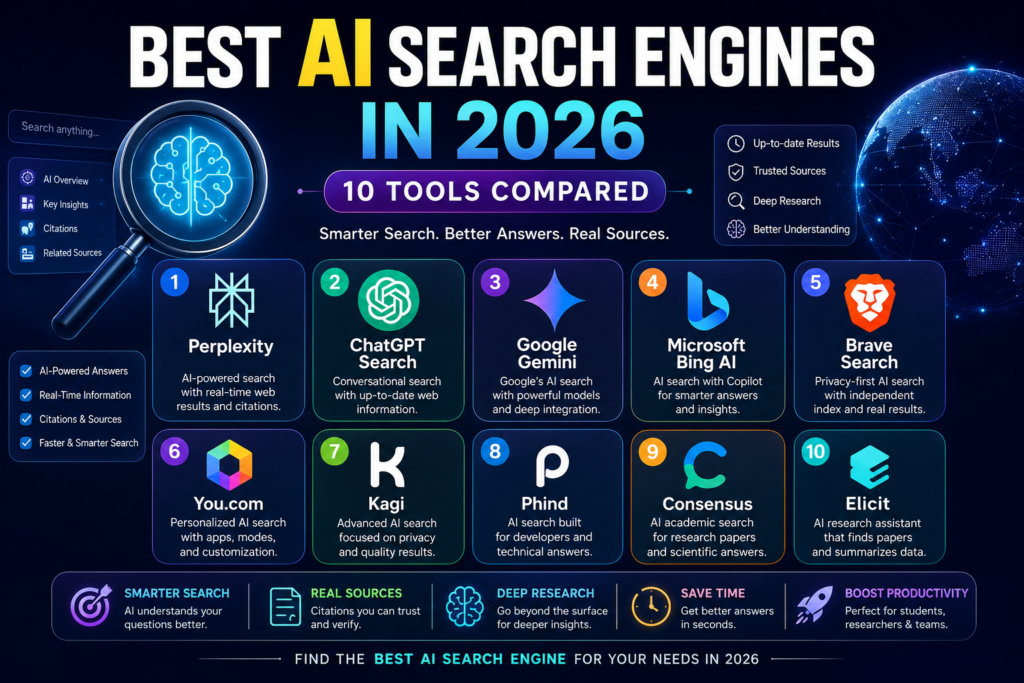
Best AI Search Engines in 2026: 10 Tools Compared
AI search engines are changing the way people find and understand information online in 2026. Instead of returning only a traditional list of web pages, modern AI search tools can understand questions, summarize information, compare sources, and help users explore a topic through natural-language conversations.
AI search can be useful for students, researchers, professionals, writers, developers, businesses, and everyday users who want faster answers without manually opening dozens of search results.
In this guide, we compare the best AI search engines in 2026 based on research capabilities, source discovery, citations, answer quality, speed, writing assistance, document analysis, ease of use, and practical everyday use cases.
Best AI Search Engines in 2026: Quick Comparison
| AI Search Tool | Best For | Sources | Ease of Use |
|---|---|---|---|
| Perplexity | Research and citations | Excellent | Excellent |
| ChatGPT | Research and general AI assistance | Excellent | Excellent |
| Gemini | Google ecosystem research | Excellent | Excellent |
| Microsoft Copilot | Web search and productivity | Excellent | Excellent |
| Claude | Research and analysis | Good | Excellent |
| Brave Search | Privacy-focused search | Good | Excellent |
| You.com | AI search and productivity | Good | Excellent |
| Phind | Developer research | Good | Excellent |
| Kagi | Premium search | Good | Excellent |
| Genspark | AI research and answers | Good | Excellent |
What Is an AI Search Engine?
An AI search engine combines traditional web search with artificial intelligence. Instead of simply displaying links, it can interpret a question and produce a summarized response based on information it finds.
Many AI search tools can also provide links or citations so users can investigate the original information. Some platforms combine search with additional capabilities such as writing, coding, document analysis, image understanding, and research workflows.
The quality of an AI search engine depends on several factors, including the quality of its search index, the AI model it uses, how it selects sources, how clearly it presents citations, and how well it handles complex questions.
1. Perplexity
Perplexity is one of the most recognizable AI-first search platforms. It is designed around conversational search and research, making it particularly useful for users who want concise answers supported by sources.
Perplexity can help users investigate current topics, compare information, summarize web pages, find sources, and continue research through follow-up questions.
Best for Perplexity
- Research
- Source discovery
- Citations
- Current information
- Fact-finding
- Research summaries
Best AI search engine for research: Perplexity is one of the strongest choices for users who prioritize sources and research-focused answers.
2. ChatGPT
ChatGPT can combine AI conversation with research and information discovery. It is useful for users who want to search for information and then continue asking questions about the results.
One of its major advantages is flexibility. A research conversation can move from searching and summarizing information to writing, brainstorming, coding, analysis, or document work without requiring a separate application.
Best for ChatGPT
- Research assistance
- Writing and editing
- Learning
- Document analysis
- Brainstorming
- Coding
- General AI assistance
Best for general-purpose AI search: ChatGPT is an excellent choice for users who want research combined with broader AI assistance.
3. Gemini
Gemini is Google’s family of AI models and assistant products. It can help users search for information, understand complex topics, summarize content, analyze documents, and work with different types of media.
Gemini can be especially convenient for people who already use Google’s ecosystem and want an AI assistant that fits naturally into their existing workflow.
Best for Gemini
- Google ecosystem users
- Research
- Learning
- Document analysis
- Multimodal tasks
- Google Workspace workflows
Best for Google users: Gemini is a strong choice for people who already rely heavily on Google services.
4. Microsoft Copilot
Microsoft Copilot combines AI assistance with Microsoft’s broader software ecosystem. It can help users search for information, answer questions, summarize content, write text, and support productivity tasks.
Copilot can be particularly useful for people who already work with Microsoft products and services.
Best for Microsoft Copilot
- Web search
- Microsoft ecosystem users
- Productivity
- Writing
- Information summaries
Best for Microsoft users: Copilot is a practical choice for users who want AI assistance connected to Microsoft’s ecosystem.
5. Claude
Claude is an AI assistant developed by Anthropic. It is particularly well known for writing, reasoning, document analysis, and knowledge-work tasks.
Claude can be useful when research requires detailed analysis rather than simply finding a quick answer. Users can provide information, ask questions, compare ideas, and turn research material into structured content.
Best for Claude
- Research analysis
- Long-form writing
- Document analysis
- Reasoning
- Coding
- Professional knowledge work
Best for analysis: Claude is a strong option when research involves detailed reading and reasoning.
6. Brave Search
Brave Search is a search engine designed with privacy in mind. It provides traditional search functionality and AI-assisted answers in a privacy-focused environment.
It can be useful for users who want search capabilities without making a large technology ecosystem the center of their search experience.
Best for Brave Search
- Privacy-focused search
- Web discovery
- Independent search
- AI-assisted answers
Best for privacy-focused AI search: Brave Search is worth considering for users who place a high value on privacy.
7. You.com
You.com combines search with AI assistance and productivity features. It can help users find information, summarize results, generate content, and work with different AI capabilities.
The platform can be useful for people who want a search experience that goes beyond traditional search results.
Best for You.com
- AI search
- Writing
- Research
- Productivity
- AI-assisted workflows
Best for AI-powered productivity search: You.com is a useful alternative for users who want search and AI tools in one platform.
8. Phind
Phind is designed with a strong focus on developers and technical questions. It can help users research programming problems, understand technical concepts, and find useful information for software development.
Developers can use AI search to investigate errors, explore frameworks, compare approaches, and understand documentation.
Best for Phind
- Programming research
- Developer questions
- Technical explanations
- Coding workflows
- Software development
Best AI search for developers: Phind is particularly useful for technical and programming-focused research.
9. Kagi
Kagi is a premium search engine focused on providing a cleaner search experience. It is designed for users who want greater control over their search experience and fewer distractions.
Kagi also offers AI-related search and answer capabilities, making it an interesting option for users who want premium search combined with modern AI features.
Best for Kagi
- Premium search
- Clean search results
- Search customization
- AI-assisted search
Best for premium search: Kagi is an attractive option for users willing to pay for a more controlled search experience.
10. Genspark
Genspark is an AI-powered research and information platform designed to help users explore topics and create useful answers from information found across the web.
It can be useful for research, planning, content discovery, and other tasks where users want AI to organize information into a more useful format.
Best for Genspark
- AI research
- Information discovery
- Research summaries
- Planning
- AI-assisted workflows
Best for AI research workflows: Genspark is an interesting option for users who want AI-assisted information discovery and research.
Best AI Search Engines by Use Case
| Use Case | Recommended Tool |
|---|---|
| Overall AI research | Perplexity |
| General-purpose AI assistance | ChatGPT |
| Google ecosystem | Gemini |
| Microsoft ecosystem | Copilot |
| Detailed analysis | Claude |
| Privacy-focused search | Brave Search |
| Developer research | Phind |
| Premium search | Kagi |
Which AI Search Engine Is Best for Research?
For research-focused users, Perplexity is one of the strongest options because its experience is centered around finding information, presenting answers, and helping users investigate sources.
ChatGPT and Gemini are also powerful research assistants, especially when users need to combine research with writing, analysis, learning, or other tasks.
Claude can be particularly useful when the research process involves detailed analysis of documents and information.
Our research pick: Perplexity is the best starting point for users who prioritize web research and source discovery, while ChatGPT, Gemini, and Claude are strong alternatives depending on the workflow.
Which AI Search Engine Is Best for Students?
Students can use AI search tools to understand difficult subjects, find background information, organize research, summarize material, and generate study questions.
Perplexity can be especially useful for finding sources and researching topics. ChatGPT and Gemini can be useful for explanations and learning, while Claude can help with detailed reading and writing.
Students should always verify important information and follow their school or university’s rules regarding AI use.
Which AI Search Engine Is Best for Businesses?
Businesses can use AI search engines for market research, competitor research, industry analysis, customer research, content creation, and information discovery.
Perplexity can be useful for research-heavy workflows, while ChatGPT and Gemini can provide broader assistance beyond search. Copilot can be attractive to organizations already using Microsoft’s ecosystem.
Companies should evaluate privacy, security, administration, integrations, pricing, and internal policies before selecting an AI search platform.
AI Search vs Traditional Search
Traditional search engines are still extremely useful for browsing websites, finding specific pages, navigating to known websites, shopping, maps, news, and many other tasks.
AI search is particularly useful when the user has a complex question and wants information summarized into a conversational answer.
The best approach is often to use both. AI search can help you understand a topic quickly, while traditional search and original sources can help you verify details and explore information directly.
How to Choose the Best AI Search Engine
Consider the following factors before choosing an AI search tool:
- Research needs: Do you need quick answers or deep research?
- Sources: How important are citations and links?
- Current information: Do you frequently research recent events or changing information?
- Writing: Do you want the search tool to help create content?
- Documents: Do you need to analyze files?
- Privacy: How important is a privacy-focused search experience?
- Ecosystem: Do you already use Google, Microsoft, or another platform?
- Price: Do you need advanced paid features?
Final Verdict: Best AI Search Engines in 2026
AI search engines have become an important part of online research in 2026. They can save time by combining search, summarization, explanation, and conversational assistance.
Perplexity is our top choice for research-focused AI search and source discovery.
ChatGPT is an excellent general-purpose option for users who want research combined with writing, learning, coding, analysis, and other AI workflows.
Gemini is particularly attractive to users who already rely heavily on Google’s ecosystem.
Claude is a strong choice for detailed analysis, long-form writing, and knowledge-work tasks.
Copilot can be especially useful for users working within Microsoft’s ecosystem.
There is no single AI search engine that is perfect for everyone. The best choice depends on the type of information you search for, how important sources are to you, and which AI ecosystem fits your workflow.
Frequently Asked Questions
What is the best AI search engine in 2026?
Perplexity is our top choice for research-focused AI search because it emphasizes conversational research and source discovery. However, ChatGPT, Gemini, Claude, and other tools may be better for specific workflows.
Is Perplexity better than Google Search?
Perplexity and traditional Google Search serve different purposes. Perplexity is useful for conversational research and summarized answers, while traditional search is excellent for browsing websites, finding specific pages, navigation, shopping, and many other tasks.
Is ChatGPT an AI search engine?
ChatGPT can provide research and web-based information capabilities in addition to its broader AI assistant features. This makes it useful for users who want search combined with writing, analysis, coding, learning, and other tasks.
Is Gemini good for research?
Yes. Gemini can help users research topics, summarize information, explain concepts, analyze documents, and explore questions. It can be particularly convenient for users who already use Google’s ecosystem.
Which AI search engine is best for students?
Perplexity is useful for source discovery and research, while ChatGPT and Gemini are strong choices for explanations and learning. Claude can also be useful for detailed reading and writing.
Which AI search engine is best for developers?
Phind can be particularly useful for developer-focused research, while ChatGPT, Gemini, Claude, and other coding assistants can provide broader programming support.
Are AI search engines accurate?
AI search engines can provide useful answers, but they can still make mistakes or misinterpret sources. Important claims should be checked against the original sources, especially for medical, legal, financial, academic, and other high-stakes information.
Can I use more than one AI search engine?
Yes. Using multiple tools can be useful because different platforms may find different sources or approach the same question differently. Comparing results can improve your research workflow.
Explore More AI Tools
If you want to explore more specialized AI software, check out these guides from AI Tool Scope:
- Best AI Research Tools in 2026
- Best AI Coding Tools in 2026
- Best AI Productivity Tools in 2026
- Best AI Presentation Makers in 2026
- Best AI Image Generators in 2026
- Best AI Video Generators in 2026
Final Thoughts
The best AI search engine is not necessarily the one with the most features. The right tool is the one that helps you find, understand, verify, and use information efficiently.
For source-focused research, Perplexity is an excellent starting point. For broader AI assistance, ChatGPT is a strong option. Gemini is particularly useful for Google-centered workflows, while Claude, Copilot, Brave Search, Phind, Kagi, You.com, and Genspark each offer different approaches to AI-powered search and information discovery.
Try several tools with the same real-world questions and compare the quality of their answers, sources, speed, and usability. This is often the best way to determine which AI search engine fits your needs.
For more AI comparisons, practical guides, and recommendations, continue exploring AI Tool Scope.