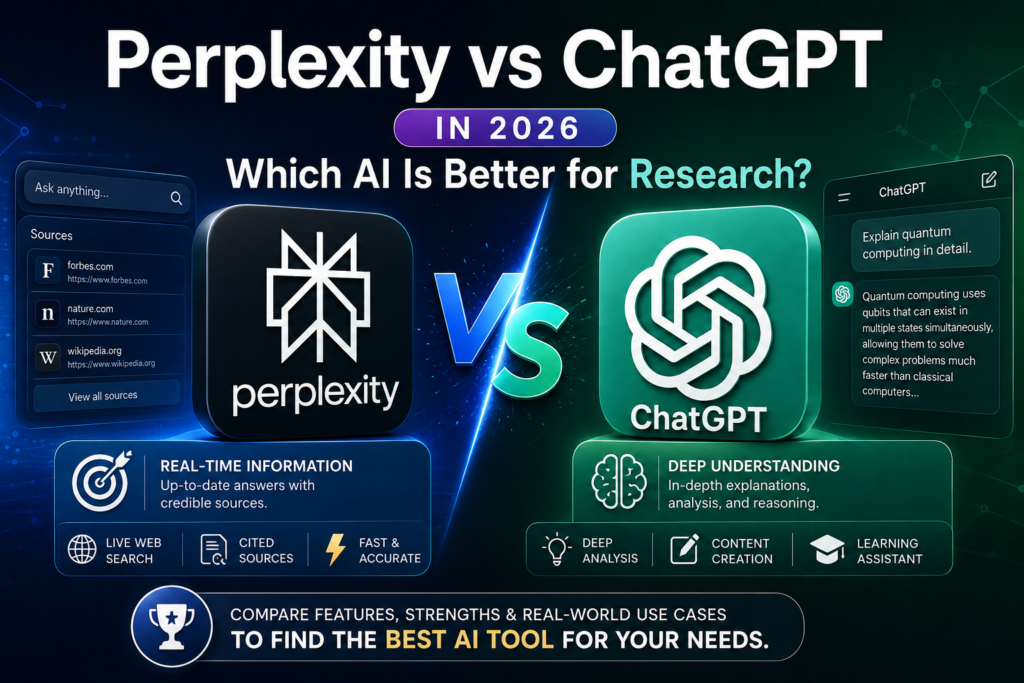
Perplexity vs ChatGPT in 2026: Which AI Is Better for Research?
Perplexity and ChatGPT are two of the most popular AI tools for finding information, answering questions, researching topics, and completing knowledge-based tasks in 2026. Both can help users understand complex subjects, summarize information, compare ideas, and generate useful answers.
However, Perplexity and ChatGPT approach information discovery differently. Perplexity is strongly focused on search, web research, and source-backed answers, while ChatGPT is designed as a broader general-purpose AI assistant that can support research alongside writing, coding, brainstorming, learning, analysis, and many other workflows.
In this guide, we compare Perplexity vs ChatGPT in 2026 across research, search, citations, writing, document analysis, coding, learning, productivity, business use, ease of use, and everyday tasks.
Perplexity vs ChatGPT: Quick Comparison
| Feature | Perplexity | ChatGPT |
|---|---|---|
| Web research | Excellent | Excellent |
| Source discovery | Excellent | Excellent |
| Citations | Excellent | Excellent |
| Writing | Excellent | Excellent |
| Document analysis | Excellent | Excellent |
| Coding | Excellent | Excellent |
| Brainstorming | Excellent | Excellent |
| Learning | Excellent | Excellent |
| General AI assistance | Excellent | Excellent |
| Search-focused workflow | Excellent | Very Good |
What Is Perplexity?
Perplexity is an AI-powered answer and research platform designed to help users search for information and receive summarized answers supported by sources. Instead of requiring users to open many search results and read them individually, Perplexity can organize information into a conversational response and provide links to the sources used.
This approach can make Perplexity particularly useful when the main goal is finding information quickly, discovering sources, comparing information, or beginning research on an unfamiliar topic.
Perplexity can be useful for students, researchers, professionals, writers, marketers, business users, and anyone who frequently needs to investigate questions on the web.
Best Uses for Perplexity
- Web research
- Source discovery
- Fact-finding
- Research summaries
- Comparing information from multiple sources
- Current information discovery
- Research planning
- Exploring unfamiliar topics
What Is ChatGPT?
ChatGPT is a general-purpose AI assistant designed to support a wide range of tasks. It can answer questions, explain concepts, write and edit content, analyze documents, assist with coding, brainstorm ideas, summarize information, and support professional and everyday workflows.
ChatGPT can also be useful for research. Users can ask questions, organize research topics, compare information, summarize documents, develop research plans, and continue a conversation to explore a subject in greater depth.
Its main advantage is breadth. Instead of being focused primarily on search and information discovery, ChatGPT can act as a research assistant as well as a writing, coding, learning, planning, and problem-solving assistant.
Best Uses for ChatGPT
- General AI assistance
- Research and analysis
- Writing and editing
- Coding
- Learning and explanations
- Document analysis
- Brainstorming
- Planning and problem solving
- Content creation
Perplexity vs ChatGPT for Research
Research is one of the most important areas where Perplexity and ChatGPT overlap. Both can help users understand a topic, summarize information, compare ideas, and organize findings.
Perplexity is particularly attractive when the first step is discovering information on the web. A user can ask a question and receive an answer that points toward sources that can be opened and reviewed.
ChatGPT can also support research by helping users define questions, analyze information, summarize documents, explain difficult concepts, and turn research material into a structured report.
The practical difference is often the workflow. Perplexity can feel more search-oriented, while ChatGPT can feel more conversation-oriented and flexible after information has been collected.
Winner for research: Perplexity has an advantage when source discovery and search are the primary goal. ChatGPT is especially strong when research needs to be combined with analysis, writing, explanation, or problem solving.
Explore the Best AI Research Tools in 2026
Perplexity vs ChatGPT for Search
Traditional search engines return a list of links that users must investigate. AI search tools attempt to make this process more conversational by understanding the question and presenting a summarized response.
Perplexity is built around this type of AI-powered search experience. It is particularly useful when you want to ask a natural-language question and quickly investigate the sources behind the answer.
ChatGPT can also help users search for and understand information when the appropriate web and research capabilities are available. It can then continue the conversation and help turn the information into a useful result.
Winner for search: Perplexity is the stronger choice for users whose main purpose is AI-powered search and source discovery.
Perplexity vs ChatGPT for Citations
Citations are important when researching topics where the origin of information matters. Users may need to check claims, read original articles, compare sources, or verify important facts.
Perplexity places strong emphasis on showing sources alongside research answers, which can make it convenient for users who want to move directly from an AI-generated summary to the underlying web pages.
ChatGPT can also provide source-supported research when its available browsing and research features are used. However, users should always open and evaluate important sources rather than assuming that an AI-generated answer is automatically correct.
Best for source-focused research: Perplexity has a strong advantage for users who prioritize visible source discovery as part of their research workflow.
Perplexity vs ChatGPT for Writing
Both platforms can help users write articles, reports, emails, summaries, social media posts, product descriptions, scripts, and other forms of content.
ChatGPT is particularly useful for iterative writing. Users can start with an idea, create an outline, generate a draft, change the tone, rewrite sections, add examples, and continue refining the content through conversation.
Perplexity can also help with writing, especially when the content requires research and source discovery. It can be useful for gathering information before producing a structured response.
Winner for writing: ChatGPT has an advantage for users who want a flexible writing partner and extensive conversational editing. Perplexity is useful when research and writing are closely connected.
Perplexity vs ChatGPT for Document Analysis
AI tools can make it easier to work with reports, articles, research papers, business documents, and other supported files.
ChatGPT can analyze supported documents, summarize their contents, answer questions, extract important information, create tables, and transform the material into outlines or explanations.
Perplexity can also support document-based research and analysis, particularly when users want to combine information from uploaded material with broader research and source discovery.
The exact features available can vary depending on the current product version, account, file type, and plan.
Best for document analysis: Both are strong choices. ChatGPT may be preferable for transforming documents into different formats, while Perplexity can be particularly useful when document analysis needs to be combined with web research.
Perplexity vs ChatGPT for Coding
Both tools can assist developers with programming questions, code explanations, debugging, examples, and technical research.
ChatGPT is designed to support conversational coding workflows. Developers can describe a problem, share code, ask for an explanation, request improvements, and work through a debugging process step by step.
Perplexity can be useful when a developer needs to research documentation, investigate technical concepts, compare libraries, or find current information about a technology.
Winner for coding: ChatGPT is generally the stronger all-purpose conversational coding assistant, while Perplexity can be particularly useful for researching technical information and sources.
Explore the Best AI Coding Tools in 2026
Perplexity vs ChatGPT for Students
Students can use both tools for research, learning, brainstorming, summarization, writing support, and understanding difficult concepts.
Perplexity can be useful when students need to discover sources, investigate a topic, compare information, and begin research for an assignment.
ChatGPT can help students understand difficult concepts, generate practice questions, explain subjects at different levels, organize study plans, summarize material, and improve written work.
Students should verify important information and follow their school’s or university’s rules regarding AI use. AI should support learning rather than replace independent understanding.
Winner for students: Perplexity is excellent for source discovery and research, while ChatGPT is a stronger all-purpose learning and tutoring assistant.
Perplexity vs ChatGPT for Business
Businesses can use AI tools to research markets, analyze competitors, summarize reports, prepare documents, draft communications, generate ideas, and support decision-making.
Perplexity can be useful for market research and information discovery because business users often need to investigate competitors, industries, products, trends, and public information.
ChatGPT can support a broader range of business workflows, including writing, analysis, brainstorming, coding, document work, planning, and content creation.
Organizations should evaluate security, privacy, administrative controls, integrations, pricing, data policies, and employee requirements before choosing an AI platform.
Best for business: There is no universal winner. Perplexity is especially useful for research-heavy workflows, while ChatGPT is attractive as a broader business assistant.
Perplexity vs ChatGPT for Everyday Tasks
For everyday users, both tools can answer questions, summarize information, explain concepts, plan activities, generate ideas, and help with writing.
Perplexity can be convenient when you want to quickly investigate a question and see supporting sources.
ChatGPT can be more useful when the task develops through conversation. You can ask follow-up questions, change the requirements, brainstorm alternatives, and continue working toward a final result.
Best for everyday use: ChatGPT is a strong all-purpose choice, while Perplexity is excellent when everyday questions require current web information or source discovery.
Perplexity vs ChatGPT for Brainstorming
Brainstorming is useful when you are starting a project, article, business idea, marketing campaign, presentation, or research topic.
ChatGPT can generate multiple ideas and continue the conversation to develop, compare, and refine them. This makes it particularly useful when brainstorming is an ongoing process.
Perplexity can also help generate ideas, especially when you want those ideas to be informed by current information, market examples, or existing sources.
Winner for brainstorming: ChatGPT has an advantage for open-ended conversational brainstorming, while Perplexity is useful when brainstorming should be grounded in web research.
Perplexity vs ChatGPT for Long-Form Research
Long-form research often involves several stages: defining a question, discovering sources, reading material, comparing information, extracting important points, and creating a final report.
Perplexity can be particularly useful during the source-discovery stage because it can help users identify relevant information and explore related questions.
ChatGPT can be valuable during the analysis and writing stages. Users can provide research material and ask for summaries, comparisons, outlines, explanations, and drafts.
Best workflow: For complex research projects, using both tools can be more effective than relying on only one. Perplexity can help discover and investigate information, while ChatGPT can help analyze and transform that information into a useful final result.
Perplexity vs ChatGPT: Which Is Easier to Use?
Both platforms are designed to be accessible without advanced technical knowledge. Users can type questions in natural language and continue with follow-up requests.
Perplexity can feel particularly simple for users who think in terms of search questions and want an answer with sources.
ChatGPT can feel more flexible for users who want to continue a conversation and use the same assistant for writing, coding, learning, research, planning, and other tasks.
Best for ease of use: Both are easy to use. Perplexity is especially straightforward for search-oriented tasks, while ChatGPT offers a broader conversational workflow.
Perplexity Strengths and Weaknesses
Perplexity Strengths
- Strong AI-powered search experience
- Excellent source discovery
- Useful research summaries
- Convenient source links and citations
- Good for current information discovery
- Useful for comparing information from multiple sources
- Strong research-oriented workflow
Perplexity Considerations
- Features can vary by plan
- AI-generated answers still require verification
- Search results and source availability can change
- It may be less suitable than a general-purpose assistant for some non-research workflows
ChatGPT Strengths and Weaknesses
ChatGPT Strengths
- Broad general-purpose AI capabilities
- Strong conversational workflows
- Excellent writing and editing assistance
- Strong coding and technical support
- Useful learning and tutoring workflows
- Document analysis and transformation
- Brainstorming and problem solving
- Useful across professional and everyday tasks
ChatGPT Considerations
- Some advanced capabilities may depend on the user’s plan
- Features can change as the product evolves
- Important information should still be checked against reliable sources
Perplexity vs ChatGPT: Which One Should You Choose?
The best choice depends on what you expect from an AI assistant.
Choose Perplexity if:
- Your main goal is web research.
- You frequently need to discover sources.
- You want answers closely connected to web pages and references.
- You often research current events, products, companies, or industries.
- You want a search-oriented AI experience.
- You frequently compare information from multiple sources.
Choose ChatGPT if:
- You want a flexible general-purpose AI assistant.
- You frequently write, rewrite, and edit content.
- You want conversational brainstorming and problem solving.
- You need coding and technical assistance.
- You want help with learning and explanations.
- You regularly analyze documents.
- You want one assistant for research and many other everyday tasks.
Can You Use Perplexity and ChatGPT Together?
Yes. In fact, using both can be an effective research workflow.
You can use Perplexity to discover sources, investigate a topic, identify different viewpoints, and collect useful information. You can then use ChatGPT to analyze the material, summarize it, organize the findings, create an outline, or turn the research into a report or article.
For example, a content creator could use Perplexity to research a topic and identify sources, then use ChatGPT to create an article based on verified information. A student could use Perplexity to discover academic or educational resources and ChatGPT to explain difficult concepts from the material.
Using both tools also gives you an opportunity to compare answers and identify information that deserves additional verification.
Perplexity vs ChatGPT: Best Tool for Different Tasks
| Task | Recommended Tool | Why |
|---|---|---|
| Web search | Perplexity | Search-focused workflow and source discovery |
| Research | Perplexity | Strong source-oriented research experience |
| Writing | ChatGPT | Flexible drafting and conversational editing |
| Coding | ChatGPT | Strong conversational programming assistance |
| Document analysis | Both | Useful for different document workflows |
| Learning | ChatGPT | Strong explanations and interactive tutoring |
| Source discovery | Perplexity | Designed around finding and exploring sources |
| Brainstorming | ChatGPT | Strong iterative conversational workflow |
| Business research | Perplexity | Useful for market and information discovery |
| General AI assistance | ChatGPT | Broad range of everyday and professional tasks |
Perplexity vs ChatGPT: Final Verdict
Perplexity and ChatGPT are both powerful AI tools in 2026, but they are optimized for somewhat different workflows.
Perplexity stands out when the primary goal is searching for information, discovering sources, researching unfamiliar subjects, and getting answers connected to web content.
ChatGPT stands out as a broader general-purpose AI assistant. It can support research, but it also works well for writing, coding, learning, brainstorming, document analysis, planning, and many other tasks.
Overall winner for research and AI search: Perplexity is our pick for users whose main priority is web research and source discovery.
Overall winner for general-purpose AI assistance: ChatGPT is our pick for users who want one flexible assistant that can handle research alongside writing, coding, learning, analysis, and everyday tasks.
The most practical approach may be to use both. Perplexity can help you discover and investigate information, while ChatGPT can help you analyze, organize, explain, and transform that information into a useful result.
Frequently Asked Questions
Is Perplexity better than ChatGPT for research?
Perplexity can have an advantage for research when source discovery, web search, and visible references are the main priorities. ChatGPT is also strong for research, especially when the task includes analysis, writing, explanation, document work, or extended conversation.
Is ChatGPT better than Perplexity?
Neither is universally better. ChatGPT is a strong general-purpose AI assistant, while Perplexity is particularly strong for search-oriented research and source discovery. The better choice depends on the task.
Is Perplexity free to use?
Perplexity offers access through different plans, and available features and limits can change over time. Users should check the current Perplexity plans before choosing a subscription.
Can Perplexity and ChatGPT search the web?
Both can support web-based information discovery when the relevant capabilities are available. The exact experience, sources, limits, and features can vary by product version and account.
Which is better for writing, Perplexity or ChatGPT?
ChatGPT is generally a stronger choice for interactive writing, rewriting, editing, brainstorming, and developing content through multiple rounds of conversation. Perplexity can be useful when writing is closely connected to web research.
Which is better for students?
Both can be useful. Perplexity is particularly helpful for finding sources and researching topics, while ChatGPT is useful for explanations, tutoring, brainstorming, writing support, and study planning.
Which is better for coding?
ChatGPT is a strong choice for conversational coding help, debugging, explanations, and code generation. Perplexity can be useful for researching technical documentation, libraries, tools, and current programming information.
Can I use Perplexity and ChatGPT together?
Yes. Using both can be useful. You can use Perplexity for source discovery and initial research, then use ChatGPT to analyze, summarize, organize, or write based on the information you have reviewed.
Which AI is better overall in 2026?
For general-purpose AI assistance, ChatGPT is our preferred choice. For AI-powered search and source-focused research, Perplexity is an excellent choice. The best option depends on your workflow.
Explore More AI Tools
If you want to explore more specialized AI software, check out these guides from AI Tool Scope:
- Best AI Research Tools in 2026
- Best AI Coding Tools in 2026
- Best AI Productivity Tools in 2026
- Best AI Presentation Makers in 2026
- Best AI Image Generators in 2026
- Best AI Video Generators in 2026
Final Thoughts
Perplexity and ChatGPT represent two useful approaches to AI assistance in 2026.
Perplexity is particularly valuable when your workflow begins with a question and you need to search the web, discover sources, compare information, and investigate a topic quickly.
ChatGPT is particularly valuable when you want to continue beyond research and use AI to write, explain, analyze, code, brainstorm, plan, or solve problems.
For research-heavy tasks, using Perplexity and ChatGPT together can provide a practical workflow: discover information, review the original sources, analyze the findings, and then turn the verified information into a useful final result.
Ultimately, the best AI tool is the one that fits your actual workflow. Try both platforms with real tasks and decide which one helps you research and complete your work more effectively.
For more AI comparisons, practical guides, and recommendations, continue exploring AI Tool Scope.