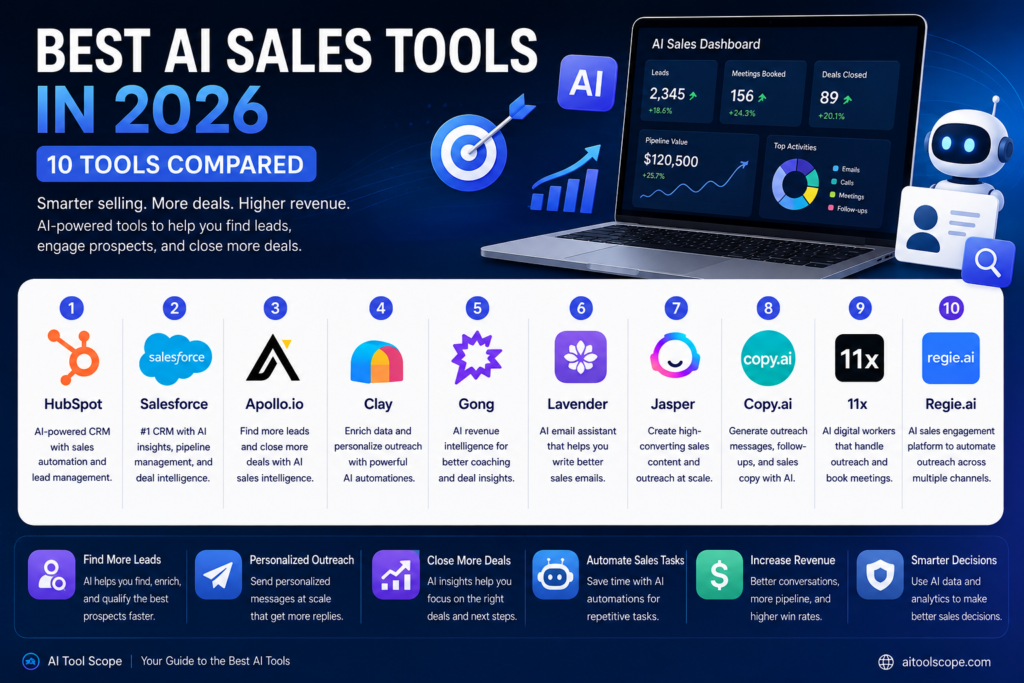
AI sales tools are changing how businesses find prospects, qualify leads, personalize outreach, manage customer relationships, automate repetitive sales tasks, and analyze conversations. In 2026, sales teams can use AI across more stages of the revenue process than ever before.
But not every AI sales platform solves the same problem. Some tools focus on prospecting and lead generation, while others specialize in CRM automation, sales engagement, conversation intelligence, forecasting, or personalized outreach.
In this guide, we compare the best AI sales tools in 2026 based on prospecting, lead generation, sales automation, CRM capabilities, personalization, conversation intelligence, ease of use, integrations, and practical value for sales teams.
If you are building a broader revenue stack, start with our Best AI Marketing Tools in 2026 guide and our Best AI Email Marketing Tools in 2026 comparison.
Best AI Sales Tools in 2026: Quick Comparison
| AI Sales Tool | Best For | Main Strength | Best For Businesses |
|---|---|---|---|
| HubSpot | All-in-one sales CRM | CRM, automation and AI-assisted sales workflows | Small to large businesses |
| Salesforce | Enterprise sales | CRM, AI and sales automation | Mid-market and enterprise teams |
| Gong | Conversation intelligence | Revenue intelligence and call analysis | Sales teams |
| Clay | Prospecting and lead enrichment | Data enrichment and AI-powered workflows | Growth and outbound teams |
| Apollo | Lead generation and outreach | Prospecting database and sales engagement | Outbound teams |
| 11x | AI sales development | AI-driven sales development workflows | Growth teams |
| Lavender | Sales emails | AI email coaching and personalization | Outbound sales teams |
| Regie.ai | Sales engagement | AI-assisted prospecting and outreach | Sales development teams |
| Avoma | Meeting intelligence | Conversation analysis and meeting workflows | Sales and customer teams |
| Drift | Conversational sales | AI-assisted website conversations and lead qualification | B2B businesses |
What Are AI Sales Tools?
AI sales tools are software platforms that use artificial intelligence, automation, machine learning, or generative AI to assist sales teams with activities such as prospecting, lead research, outreach, qualification, CRM management, meeting analysis, forecasting, and follow-up.
Some tools automate repetitive sales tasks, while others provide intelligence that helps sales representatives make better decisions. The right solution depends on your sales process, customer type, team size, sales cycle, CRM, and budget.
AI can be especially useful when sales teams spend significant time researching prospects, writing repetitive messages, updating CRM records, summarizing meetings, or identifying follow-up opportunities.
If your main focus is generating demand before a lead reaches sales, see our Best AI Marketing Tools in 2026 guide. If email campaigns are your primary acquisition channel, explore Best AI Email Marketing Tools in 2026.
1. HubSpot
Best for: All-in-one sales CRM, automation, and AI-assisted workflows
HubSpot combines CRM, sales engagement, automation, reporting, and customer data in one platform. Its AI features can help sales teams research prospects, create content, summarize information, automate repetitive tasks, and support different stages of the sales process.
HubSpot can be especially useful for businesses that want marketing and sales data connected rather than managed in separate systems.
Explore the official HubSpot Sales Hub page for current sales features.
For the marketing side of the same customer journey, see our AI marketing tools comparison.
Why sales teams may like HubSpot
- CRM-connected sales workflows
- AI-assisted sales tasks
- Lead and contact management
- Sales automation
- Reporting and pipeline visibility
Best for: Businesses that want CRM, sales automation, and customer information in one ecosystem.
2. Salesforce
Best for: Enterprise sales teams and complex CRM operations
Salesforce is a large CRM platform with sales automation, analytics, customer data, and AI capabilities. Its AI features are designed to assist sales representatives and teams with tasks such as prospect research, recommendations, summaries, and workflow automation.
Salesforce is particularly relevant to larger organizations that require extensive customization, integrations, governance, and sales processes.
Visit the official Salesforce Sales page for current capabilities.
Why sales teams may like Salesforce
- Powerful CRM platform
- Extensive customization
- AI-assisted sales workflows
- Large integration ecosystem
- Suitable for complex organizations
Best for: Mid-market and enterprise organizations with complex sales operations.
3. Gong
Best for: Conversation intelligence and revenue insights
Gong focuses on revenue intelligence and analyzing customer conversations. Sales teams can use conversation data to understand what prospects discuss, identify patterns, improve coaching, and uncover opportunities for follow-up.
This type of AI is different from a simple writing assistant because the value comes from analyzing interactions and turning conversation data into sales insights.
Learn more from the official Gong platform page.
Why sales teams may like Gong
- Conversation intelligence
- Sales coaching insights
- Call and meeting analysis
- Revenue intelligence
- Useful for improving sales performance
Best for: Sales organizations that want deeper insight into calls, meetings, and customer conversations.
4. Clay
Best for: Prospecting, lead enrichment, and outbound research
Clay is designed for data-driven prospecting and enrichment workflows. It can help sales and growth teams gather information about prospects, enrich lead records, research accounts, and create personalized outbound workflows.
Clay is particularly interesting for teams that want to combine multiple data sources with AI-assisted research and personalization.
Explore the official Clay website for its current prospecting and enrichment capabilities.
Why sales teams may like Clay
- Lead enrichment
- Prospect research
- Data-driven outbound workflows
- AI-assisted personalization
- Useful for growth teams
Best for: Growth and outbound teams that need flexible prospect research and enrichment.
5. Apollo
Best for: Lead generation, prospecting, and sales engagement
Apollo combines a prospecting database with sales engagement features. It can help teams identify potential buyers, research contacts, organize outreach, and manage sales engagement workflows.
AI can make prospecting and message creation faster, but the quality of the underlying targeting and sales strategy remains important.
Visit the official Apollo website to review its current sales intelligence and engagement features.
Why sales teams may like Apollo
- Prospecting database
- Lead generation
- Sales engagement workflows
- Contact research
- Useful for outbound teams
Best for: Sales development teams that need prospecting data and outbound engagement in one platform.
6. 11x
Best for: AI-driven sales development workflows
11x focuses on AI-powered digital workers and sales development workflows. Its approach is designed around automating parts of prospecting and sales development rather than simply assisting a representative with individual tasks.
This category is evolving quickly, so businesses should evaluate the exact workflows, integrations, data requirements, and human oversight offered by the current product.
Explore the official 11x website for current information.
Why sales teams may consider 11x
- AI-driven sales development
- Prospecting automation
- Workflow-oriented approach
- Designed for outbound operations
- Potential to reduce repetitive work
Best for: Growth organizations experimenting with highly automated sales development.
7. Lavender
Best for: AI sales email coaching and personalization
Lavender focuses on improving sales emails. It can provide AI-assisted guidance around email quality, personalization, clarity, and effectiveness.
For sales representatives who already have a prospect list but struggle to write effective outbound emails, an email coaching layer can be more useful than adopting a completely new CRM.
Visit the official Lavender website for current features.
Why sales teams may like Lavender
- AI sales email coaching
- Email personalization assistance
- Useful for outbound messaging
- Helps improve clarity and relevance
- Can complement existing sales tools
Best for: Sales representatives and outbound teams focused on improving email outreach.
8. Regie.ai
Best for: AI-assisted sales engagement and prospecting
Regie.ai is focused on AI-powered sales engagement and prospecting workflows. It can help teams create personalized outreach, support prospecting activities, and coordinate sales engagement processes.
Its value is strongest when AI is integrated into an existing sales development workflow rather than used as an isolated copy generator.
Learn more at the official Regie.ai website.
Why sales teams may like Regie.ai
- AI-assisted prospecting
- Personalized sales outreach
- Sales engagement workflows
- Useful for sales development teams
- Can reduce repetitive writing tasks
Best for: Sales development teams that want AI integrated into outbound engagement.
9. Avoma
Best for: Meeting intelligence and sales conversations
Avoma provides meeting and conversation intelligence for sales and customer-facing teams. It can help record, transcribe, summarize, analyze, and organize information from customer conversations.
Meeting intelligence can be valuable because important customer information is often buried in calls and meetings rather than written directly into a CRM.
Visit the official Avoma website for current capabilities.
Why sales teams may like Avoma
- Meeting transcription
- AI-generated summaries
- Conversation insights
- Sales meeting workflows
- Useful for coaching and follow-up
Best for: Sales teams that want to capture and use insights from customer meetings.
10. Drift
Best for: Conversational sales and website lead qualification
Drift focuses on conversational marketing and sales experiences. AI-assisted website conversations can help businesses engage visitors, answer questions, qualify leads, and connect prospects with sales teams.
This makes conversational AI particularly useful when a business receives meaningful website traffic but wants to improve how quickly visitors become qualified opportunities.
Explore the official Drift website for current conversational sales capabilities.
Why sales teams may like Drift
- Website conversations
- Lead qualification
- Conversational sales workflows
- AI-assisted visitor engagement
- Useful for B2B businesses
Best for: B2B companies that want to convert website visitors into sales conversations.
How to Choose the Best AI Sales Tool
The best AI sales platform depends on where your sales process has the biggest bottleneck. A prospecting team may need data and enrichment, while an account executive may need conversation intelligence and CRM automation.
For CRM and sales automation
HubSpot and Salesforce are strong options when you want CRM data, pipeline management, automation, reporting, and AI capabilities in a broader sales ecosystem.
For prospecting and lead generation
Clay and Apollo are useful to investigate when finding, researching, and enriching prospects is a major part of your outbound process.
For sales conversations
Gong and Avoma are designed around conversation and meeting intelligence. These tools can be useful when managers and representatives need better visibility into customer discussions.
For sales email outreach
Lavender, Regie.ai, and other sales engagement tools can help teams create, personalize, and improve outbound messages.
If email marketing rather than one-to-one sales outreach is your main requirement, see our Best AI Email Marketing Tools in 2026 guide.
For conversational website sales
Drift can be worth considering when website visitors are an important source of leads and the business wants faster qualification and sales conversations.
AI Sales Tools vs AI Marketing Tools
AI marketing tools generally focus on attracting and nurturing audiences through content, advertising, SEO, social media, email, and campaigns. AI sales tools focus more directly on prospects, opportunities, sales conversations, pipeline management, outreach, and revenue operations.
The two categories work best together. Marketing can create demand and generate leads, while sales tools can help qualify those leads and move them through the pipeline.
For a broader overview of marketing software, see our Best AI Marketing Tools in 2026 comparison.
How to Build an AI Sales Workflow
- Find prospects: Identify companies and contacts that match your ideal customer profile.
- Research: Gather relevant information about the prospect, company, industry, and potential needs.
- Enrich: Improve contact and account data before starting outreach.
- Personalize: Create relevant messages instead of sending identical generic emails.
- Engage: Use email, calls, meetings, or website conversations to communicate with prospects.
- Capture insights: Record and summarize important customer conversations.
- Follow up: Automate appropriate reminders and follow-up tasks without sacrificing personalization.
- Measure: Track qualified leads, meetings, opportunities, conversion rates, sales cycle length, and revenue.
- Improve: Use performance and conversation data to refine targeting, messaging, and sales processes.
This workflow also connects naturally with marketing. Businesses can use AI marketing tools to generate demand and then use AI sales tools to manage the resulting opportunities.
How AI Can Improve Sales Productivity
AI can reduce repetitive administrative work and give sales representatives more time for customer conversations and high-value activities.
- Research prospects
- Enrich lead records
- Generate personalized outreach
- Summarize calls and meetings
- Identify follow-up actions
- Automate repetitive CRM tasks
- Analyze sales conversations
- Prioritize opportunities
- Support sales forecasting and reporting
However, sales teams should not treat AI output as automatically accurate. Customer information, personalization, pricing, product claims, and important communications should receive appropriate human review.
Best AI Sales Tools in 2026: Final Verdict
There is no single AI sales tool that is best for every sales organization.
HubSpot is a strong option for businesses that want CRM, sales automation, and customer data in one ecosystem. Salesforce is better suited to many larger organizations with complex CRM requirements and extensive customization.
Gong and Avoma are useful for conversation and meeting intelligence. Clay and Apollo are strong categories to investigate for prospecting, lead research, enrichment, and outbound workflows.
Lavender is focused on improving sales emails, while Regie.ai supports AI-assisted sales engagement. 11x represents a more automation-heavy approach to sales development, while Drift focuses on conversational website sales.
Overall recommendation: Start with the biggest bottleneck in your sales process. Do not buy several AI sales tools simply because they have impressive features. Choose the platform that improves a measurable part of your workflow, integrate it carefully, and evaluate the effect on qualified opportunities and revenue.
Frequently Asked Questions
What are the best AI sales tools in 2026?
The best tool depends on the sales task. HubSpot and Salesforce are strong CRM options, Gong and Avoma focus on conversation intelligence, Clay and Apollo support prospecting, and tools such as Lavender and Regie.ai focus more heavily on sales outreach.
Can AI sales tools replace sales representatives?
AI can automate repetitive tasks and assist with research, writing, summaries, and workflow management, but sales still depends heavily on trust, judgment, negotiation, relationships, and understanding customer needs.
Which AI sales tool is best for prospecting?
Clay and Apollo are useful options to evaluate for prospect research, lead generation, enrichment, and outbound workflows. The best choice depends on your target market, data requirements, integrations, and sales process.
Which AI sales tool is best for CRM?
HubSpot and Salesforce are major CRM platforms with AI capabilities. HubSpot can be attractive for businesses wanting an integrated and approachable ecosystem, while Salesforce is often suited to more complex enterprise requirements.
Which AI sales tool is best for sales emails?
Lavender is specifically focused on sales email coaching and personalization. Other sales engagement platforms can also assist with outbound messaging and workflow automation.
Which AI sales tools analyze sales calls?
Gong and Avoma are examples of platforms focused on conversation and meeting intelligence. They can help teams capture, summarize, and analyze customer interactions.
Can AI personalize sales outreach?
Yes. AI can help research prospects and generate personalized messages. However, personalization should be based on accurate information and reviewed by a human before important outreach is sent.
Are AI sales tools worth paying for?
They can be valuable when they reduce repetitive work, improve prospect research, increase sales productivity, or help teams identify and act on opportunities more effectively. Businesses should compare subscription costs with measurable improvements in qualified leads, meetings, conversion rates, and revenue.
Related AI Tool Scope Guides
- Best AI Marketing Tools in 2026
- Best AI Email Marketing Tools in 2026
- Best AI Writing Tools in 2026
- Best AI Productivity Tools in 2026
- Best AI Research Tools in 2026
- Best AI SEO Tools in 2026
Final Thoughts
AI sales tools are becoming an important part of modern revenue operations. They can help businesses research prospects, automate repetitive work, personalize outreach, analyze conversations, manage customer data, and improve sales productivity.
The best approach is to choose tools based on specific sales problems rather than collecting as many AI products as possible.
For prospecting, prioritize data quality and research. For outreach, prioritize personalization and workflow efficiency. For sales management, prioritize CRM integration and pipeline visibility. For conversations, prioritize accurate meeting intelligence and useful insights.
As your sales operation grows, you can connect AI sales tools with marketing, email, research, productivity, and customer-management workflows to create a more efficient revenue process.
For more AI comparisons, practical guides, and recommendations, continue exploring AI Tool Scope.