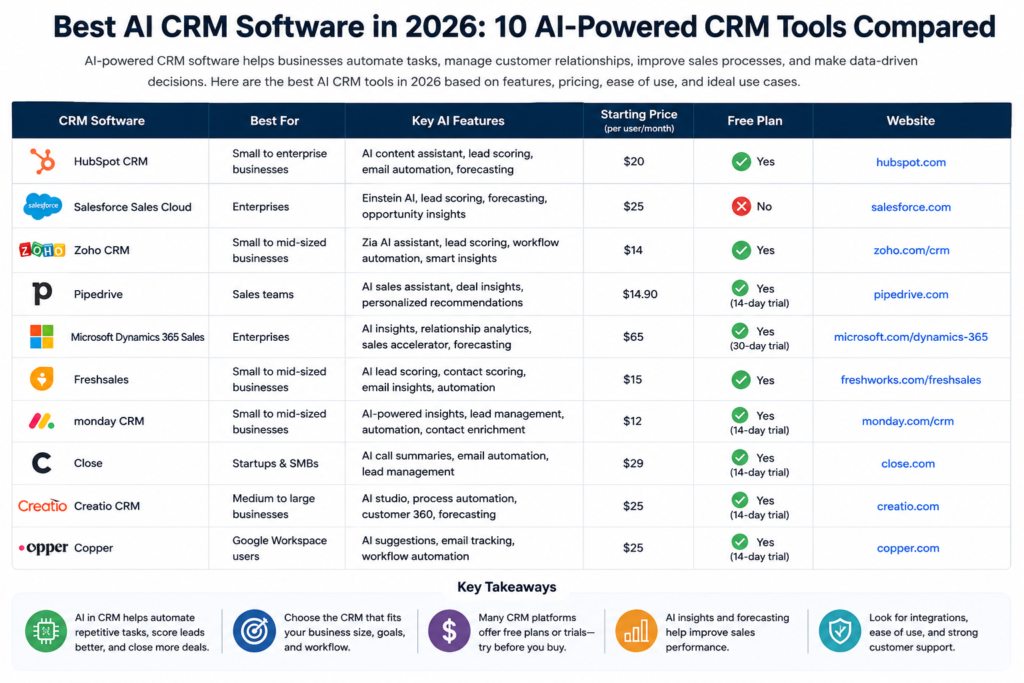
The best AI CRM software in 2026 can help businesses organize customer data, manage sales pipelines, automate repetitive tasks, prioritize leads, personalize customer interactions, and improve revenue forecasting.
Modern CRM platforms are moving beyond simple contact databases. AI can now assist with lead scoring, data enrichment, sales recommendations, email drafting, conversation summaries, forecasting, workflow automation, and customer insights.
But AI CRM platforms are not all built for the same type of business. Some are designed for small businesses and simple pipelines, while others target enterprise organizations with complex sales processes, advanced automation, analytics, and integrations.
In this guide, we compare the best AI CRM software in 2026 based on AI capabilities, contact management, sales pipelines, automation, analytics, ease of use, integrations, scalability, and practical value.
If you are also evaluating sales automation, see our Best AI Sales Tools in 2026 guide. For broader marketing workflows, explore our Best AI Marketing Tools in 2026 comparison.
Best AI CRM Software in 2026: Quick Comparison
| AI CRM Software | Best For | Key Strength | Best For Businesses |
|---|---|---|---|
| HubSpot CRM | All-in-one CRM | CRM, AI, sales and marketing automation | Small to large businesses |
| Salesforce | Enterprise CRM | Advanced CRM, AI and customization | Mid-market and enterprise |
| Zoho CRM | Value and flexibility | AI-assisted CRM and automation | Small and growing businesses |
| Microsoft Dynamics 365 | Enterprise operations | CRM, AI and Microsoft ecosystem | Enterprise teams |
| Pipedrive | Sales pipeline management | Visual pipeline and AI assistance | Small sales teams |
| Freshsales | AI-assisted sales CRM | Lead scoring and sales automation | Small and mid-size teams |
| monday CRM | Flexible CRM workflows | Customizable workflows and automation | Growing teams |
| Close | Inside sales | Calling, email and sales workflows | Sales teams |
| Creatio | CRM automation | No-code workflows and AI | Mid-market organizations |
| Copper | Google Workspace CRM | CRM integrated with Google tools | Small businesses |
What Is AI CRM Software?
AI CRM software is customer relationship management software that uses artificial intelligence, machine learning, automation, or generative AI to help businesses manage customer information and revenue workflows.
Traditional CRM systems organize contacts, accounts, deals, activities, and communication history. AI-enhanced CRM systems can go further by identifying patterns, suggesting next actions, summarizing conversations, scoring leads, generating content, and automating repetitive processes.
The best solution depends on your sales process, customer lifecycle, team size, existing technology, and budget. A small company may need a simple CRM with AI assistance, while an enterprise may require extensive customization, governance, analytics, and integrations.
How to Choose the Best AI CRM Software in 2026
Choosing the best AI CRM software in 2026 starts with identifying what your team actually needs from a customer management system.
- Contact management: Look for reliable customer and company records.
- Pipeline management: Choose a CRM that matches your sales process.
- AI assistance: Evaluate lead scoring, summaries, recommendations, forecasting, and generative AI features.
- Automation: Look for workflows that reduce repetitive administrative work.
- Reporting: Consider dashboards, forecasting, attribution, and sales analytics.
- Integrations: Make sure the CRM connects with your email, marketing, support, and productivity tools.
- Scalability: Choose software that can grow with your team without creating unnecessary complexity.
- Total cost: Compare subscription costs, add-ons, implementation, and training.
1. HubSpot CRM
Best for: All-in-one CRM, sales, marketing, and AI automation
HubSpot CRM combines customer relationship management with sales, marketing, service, and automation capabilities. Its AI features can assist teams with customer data, content, prospecting, sales tasks, reporting, and workflow automation.
HubSpot is particularly attractive when a business wants customer information connected across marketing and sales rather than maintained in separate systems.
Why consider HubSpot?
- CRM and customer data management
- AI-assisted sales workflows
- Marketing and sales integration
- Automation and reporting
- Useful for growing businesses
Best for: Businesses that want one connected platform for CRM, sales, marketing, and automation.
2. Salesforce
Best for: Enterprise CRM and advanced AI capabilities
Salesforce is a major CRM platform designed for organizations with complex customer and revenue operations. Its AI capabilities can support sales representatives with insights, recommendations, summaries, automation, and customer data.
Salesforce is particularly relevant for organizations that need deep customization, extensive integrations, advanced security controls, and sophisticated CRM processes.
Why consider Salesforce?
- Enterprise-grade CRM
- AI-assisted sales workflows
- Advanced customization
- Large integration ecosystem
- Strong reporting and analytics
Best for: Mid-market and enterprise organizations with complex CRM requirements.
3. Zoho CRM
Best for: Flexible CRM at a competitive value
Zoho CRM provides customer management, sales automation, analytics, workflows, and AI-assisted capabilities. Its broader software ecosystem can also help businesses connect CRM with other operational functions.
Zoho can be attractive to growing businesses that want extensive functionality without necessarily adopting an enterprise-first CRM environment.
Why consider Zoho CRM?
- Contact and deal management
- Sales automation
- AI-assisted CRM features
- Workflow customization
- Broad business software ecosystem
Best for: Small and growing businesses that want flexibility and a broad CRM feature set.
4. Microsoft Dynamics 365
Best for: Enterprise CRM and Microsoft ecosystem integration
Microsoft Dynamics 365 combines CRM and business applications with AI capabilities across sales, customer service, marketing, and other business functions.
Organizations already using Microsoft products may find the broader ecosystem useful for connecting customer information, productivity tools, analytics, and business workflows.
Why consider Dynamics 365?
- Enterprise CRM capabilities
- AI-assisted business workflows
- Microsoft ecosystem integration
- Advanced analytics
- Suitable for complex organizations
Best for: Enterprises that want CRM connected with a wider Microsoft technology environment.
5. Pipedrive
Best for: Visual sales pipelines and smaller sales teams
Pipedrive focuses on sales pipeline management and provides automation, reporting, integrations, and AI-assisted sales capabilities.
Its visual approach can make it easier for sales teams to understand deal stages, prioritize activities, and manage opportunities without the complexity of a large enterprise CRM.
Why consider Pipedrive?
- Visual sales pipeline
- Deal and activity management
- Sales automation
- AI-assisted productivity
- Useful for smaller sales teams
Best for: Small and mid-size sales teams that prioritize pipeline visibility and ease of use.
6. Freshsales
Best for: AI-assisted sales CRM
Freshsales is a CRM platform from Freshworks that combines contact management, sales activities, automation, analytics, and AI-assisted sales capabilities.
It can be useful for businesses that want lead management and sales automation without adopting an overly complex enterprise system.
Why consider Freshsales?
- Contact and lead management
- Sales automation
- AI-assisted sales features
- Reporting and analytics
- Useful for growing businesses
Best for: Small and mid-size businesses looking for an AI-assisted sales CRM.
7. monday CRM
Best for: Flexible CRM workflows and team collaboration
monday CRM provides customizable CRM workflows designed around leads, contacts, deals, activities, and team collaboration.
Its flexible structure can be useful for businesses that want to adapt CRM workflows to their own processes instead of following a rigid sales model.
Why consider monday CRM?
- Customizable CRM workflows
- Visual pipeline management
- Automation
- Team collaboration
- Flexible project-style workflows
Best for: Growing teams that want a flexible CRM they can adapt to different workflows.
8. Close
Best for: Inside sales and communication-heavy teams
Close is designed around sales teams that spend significant time calling, emailing, and following up with prospects. It combines CRM records with communication and sales workflow capabilities.
This approach can be particularly useful for inside sales teams that want customer records and sales communication managed in one environment.
Why consider Close?
- Sales CRM
- Email and calling workflows
- Lead management
- Follow-up automation
- Useful for inside sales teams
Best for: Sales teams where calls, emails, and frequent follow-ups are central to the sales process.
9. Creatio
Best for: CRM automation and no-code workflows
Creatio focuses on CRM, workflow automation, and no-code business process management. Its approach can be useful for organizations that want to build and customize customer-facing processes without extensive traditional development.
Why consider Creatio?
- CRM and workflow automation
- No-code process customization
- AI-assisted capabilities
- Flexible business processes
- Useful for complex workflows
Best for: Organizations that need customizable CRM and business process automation.
10. Copper
Best for: Google Workspace-focused businesses
Copper is a CRM designed with a strong focus on Google Workspace users. It can help teams manage relationships, opportunities, tasks, and customer information while working within familiar productivity tools.
This can make Copper particularly interesting for small businesses and teams that already rely heavily on Gmail, Google Calendar, and related Google Workspace applications.
Why consider Copper?
- CRM and relationship management
- Google Workspace integration
- Pipeline management
- Task and activity tracking
- Useful for small teams
Best for: Businesses that want CRM functionality closely connected to Google Workspace.
AI CRM Software vs AI Sales Tools
AI CRM software and AI sales tools overlap, but they are not identical categories.
A CRM is usually the central system for managing contacts, companies, deals, activities, customer history, and pipeline information. AI sales tools often focus on specific sales tasks such as prospecting, outreach, email personalization, call analysis, or sales development.
A business may therefore use a CRM as its central source of customer data while connecting specialized AI sales tools to improve prospecting and sales productivity.
For a broader list of specialized sales platforms, see our Best AI Sales Tools in 2026 comparison.
AI CRM Software vs AI Marketing Tools
AI marketing tools generally focus on attracting and nurturing audiences through content, advertising, SEO, social media, and campaigns. CRM software focuses on organizing customer relationships and connecting interactions to leads, accounts, opportunities, and revenue.
The strongest business workflows connect these systems so marketing activity can inform sales while CRM data can improve audience segmentation and customer communication.
Explore our Best AI Marketing Tools in 2026 guide for a broader marketing software comparison.
How to Build an AI-Powered CRM Workflow
- Capture customer data: Store contacts, companies, opportunities, and relevant interactions in the CRM.
- Organize the pipeline: Define clear stages that match your sales process.
- Enrich records: Add useful customer and company information where appropriate.
- Prioritize leads: Use scoring and relevant signals to identify promising opportunities.
- Automate routine work: Reduce repetitive data entry, reminders, assignments, and follow-ups.
- Use AI assistance: Generate summaries, draft messages, identify patterns, and surface recommendations.
- Track performance: Monitor pipeline value, conversion rates, sales cycle length, and revenue.
- Review and improve: Use performance data to refine the CRM process.
What AI Can Do Inside a CRM
AI can support many CRM activities, but the exact capabilities vary by platform and subscription plan.
- Lead scoring and prioritization
- Customer and account summaries
- Email and message drafting
- Sales recommendations
- Data enrichment and classification
- Meeting and conversation summaries
- Forecasting assistance
- Workflow automation
- Customer segmentation
- Performance analysis
AI-generated recommendations should still be reviewed when they affect important customer decisions, pricing, commitments, or business records.
Best AI CRM Software for Small Businesses
Small businesses should prioritize ease of use, total cost, integrations, and the ability to manage contacts and deals without excessive complexity.
HubSpot, Zoho CRM, Pipedrive, Freshsales, monday CRM, and Copper are worth evaluating depending on the workflow and software ecosystem already used by the business.
Best AI CRM Software for Enterprise
Enterprise organizations typically need more than contact management. Security, customization, governance, integrations, analytics, workflow complexity, user permissions, and scalability can become major factors.
Salesforce and Microsoft Dynamics 365 are particularly relevant to organizations that require sophisticated CRM infrastructure. Other platforms may be appropriate depending on the specific operational requirements.
Best AI CRM Software in 2026: Final Verdict
The best AI CRM software in 2026 depends on your business model, sales process, team size, technology stack, and level of CRM complexity.
HubSpot is a strong all-in-one choice for businesses that want CRM connected to marketing and sales. Salesforce is highly suited to complex enterprise requirements, while Zoho CRM offers a flexible option for growing businesses.
Microsoft Dynamics 365 is attractive for organizations invested in the Microsoft ecosystem. Pipedrive is useful for teams focused on visual sales pipelines, while Freshsales provides AI-assisted sales CRM capabilities.
monday CRM is a flexible option for collaborative workflows, Close is designed for communication-heavy inside sales, Creatio focuses on CRM and process automation, and Copper is particularly relevant to Google Workspace users.
Overall recommendation: Choose the CRM that fits your actual customer journey rather than selecting the platform with the longest feature list. Start with contact management, pipeline visibility, automation, reporting, and integrations, then evaluate whether the AI features produce measurable improvements.
Frequently Asked Questions
What is the best AI CRM software in 2026?
There is no universal winner. HubSpot is a strong all-in-one option, Salesforce is suited to complex enterprise environments, Zoho CRM offers flexibility, Pipedrive focuses on sales pipelines, and other platforms specialize in particular business workflows.
What does AI do in a CRM?
AI can assist with lead scoring, customer summaries, email drafting, recommendations, forecasting, data classification, workflow automation, and analysis. Capabilities vary by platform and plan.
Can AI CRM software replace salespeople?
AI can automate repetitive administrative work and assist representatives, but customer relationships, negotiation, judgment, and strategic decisions still require human involvement.
Which AI CRM is best for small businesses?
Small businesses should compare HubSpot, Zoho CRM, Pipedrive, Freshsales, monday CRM, and Copper based on their budget, sales process, required integrations, and ease of use.
Which AI CRM is best for enterprise businesses?
Salesforce and Microsoft Dynamics 365 are major enterprise CRM options. The right choice depends on organizational complexity, existing technology, customization requirements, security, and implementation needs.
Can AI CRM software improve sales?
It can help sales teams organize information, prioritize opportunities, automate repetitive work, and respond more efficiently. Actual sales improvement depends on implementation, data quality, sales strategy, and customer demand.
Can a CRM use AI to write emails?
Many modern CRM platforms include AI-assisted writing features. These can help draft or personalize messages, but important customer communications should receive human review.
Should I use an AI CRM with other AI sales tools?
Yes, when there is a clear reason. A CRM can remain the central customer database while specialized AI tools handle prospecting, outreach, conversation intelligence, or other specific sales tasks.
Related AI Tool Scope Guides
- Best AI Sales Tools in 2026
- Best AI Marketing Tools in 2026
- Best AI Email Marketing Tools in 2026
- Best AI Productivity Tools in 2026
- Best AI Research Tools in 2026
- Best AI SEO Tools in 2026
Final Thoughts
AI CRM software is becoming more than a place to store customer records. Modern platforms can combine customer data with AI-assisted recommendations, automation, sales intelligence, and workflow management.
The best approach is to start with your customer journey and identify the CRM problems that consume the most time or create the most friction. Then choose a platform that solves those problems without adding unnecessary complexity.
As your organization grows, AI CRM can become the central layer connecting marketing, sales, customer service, analytics, and specialized AI tools.
For more AI comparisons, practical guides, and recommendations, continue exploring AI Tool Scope.