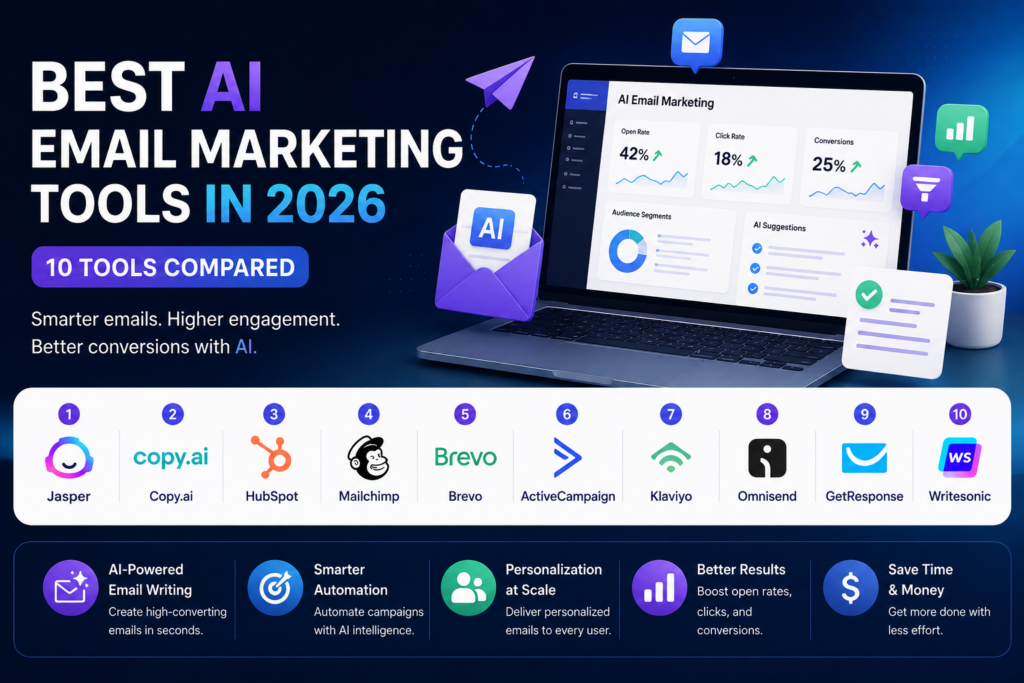
Email marketing remains one of the most useful channels for businesses, creators, ecommerce brands, and publishers. In 2026, AI is making email marketing faster by helping teams write campaigns, personalize messages, segment audiences, optimize send times, automate customer journeys, and analyze performance.
However, AI email marketing tools are not all designed for the same job. Some focus on AI copywriting, while others combine email campaigns with CRM data, automation, ecommerce personalization, analytics, or customer journeys.
In this guide, we compare the best AI email marketing tools in 2026 across email writing, automation, personalization, segmentation, ecommerce, analytics, ease of use, and overall value.
If you are building a broader marketing stack, start with our Best AI Marketing Tools in 2026 guide, then use this article to focus specifically on email campaigns and automation.
Best AI Email Marketing Tools in 2026: Quick Comparison
| Tool | Best For | Key Strength | Best For |
|---|---|---|---|
| HubSpot | All-in-one email marketing | CRM, AI, personalization and automation | Growing businesses |
| GetResponse | Email automation | AI content and visual workflows | Small businesses and marketers |
| ActiveCampaign | Advanced automation | AI-assisted campaigns and customer journeys | Automation-heavy teams |
| Klaviyo | Ecommerce email | Behavioral personalization and predictive data | Ecommerce brands |
| Mailchimp | Email campaigns | Simple campaign creation and optimization | Small businesses |
| Brevo | Affordable marketing automation | Email, automation and customer communication | Small and growing businesses |
| Omnisend | Ecommerce automation | Email and SMS customer journeys | Online stores |
| Jasper | AI email copy | Marketing-focused content generation | Marketing teams |
| Copy.ai | Email and GTM workflows | AI workflow automation | Sales and marketing teams |
| Writesonic | AI email content | Fast campaign copy and templates | Content marketers |
What Are AI Email Marketing Tools?
AI email marketing tools use artificial intelligence, automation, predictive models, or generative AI to help marketers create, personalize, send, and analyze email campaigns.
Depending on the platform, AI can help with subject lines, email body copy, audience segmentation, personalization, send-time optimization, campaign analysis, and automated customer journeys.
Modern platforms increasingly combine AI with first-party customer data. This allows businesses to create more relevant messages instead of simply generating generic email copy. AI can handle repetitive work, while marketers remain responsible for strategy, brand voice, accuracy, and compliance.
If you are interested in broader marketing software, see our Best AI Marketing Tools in 2026 guide. For content-focused workflows, explore Best AI Writing Tools in 2026. For search visibility, see Best AI SEO Tools in 2026.
1. HubSpot
Best for: All-in-one email marketing, CRM, personalization, and automation
HubSpot combines email marketing with CRM data, marketing automation, analytics, and customer management. Its AI-powered email capabilities can help marketers generate email content, personalize messages, optimize targeting, and improve campaign performance.
HubSpot’s current AI-powered email offering supports generating branded emails, creating personalized content using CRM information, and recommending audiences and send times. Some advanced AI email features depend on the Marketing Hub plan.
Learn more on the official HubSpot email marketing page.
For the broader marketing stack around email, CRM, campaigns, and automation, see our AI marketing tools comparison.
Why marketers may like HubSpot
- CRM-connected email marketing
- AI-assisted email creation
- Audience segmentation and personalization
- Marketing automation
- Campaign reporting and analytics
Best for: Businesses that want email marketing connected to CRM and broader marketing operations.
2. GetResponse
Best for: Email automation and campaign creation
GetResponse is an email marketing and automation platform that combines campaigns, automation, landing pages, lead generation, and AI-assisted content creation.
Its AI features can help generate email copy and subject lines, while its automation tools can support customer journeys and follow-up campaigns.
Visit the official GetResponse website for current features and plans.
Why marketers may like GetResponse
- AI-assisted email content
- Marketing automation
- Landing pages and lead capture
- Visual workflow builder
- Useful for small and growing businesses
Best for: Businesses that want email campaigns, automation, and lead generation in one platform.
3. ActiveCampaign
Best for: Advanced email automation and customer journeys
ActiveCampaign combines email marketing, automation, CRM capabilities, and AI-assisted campaign creation. It is particularly useful for businesses that need behavior-based customer journeys rather than simple newsletter sending.
Its current platform includes AI-assisted email creation, automation capabilities, and AI-driven recommendations around send times, subject lines, and content.
Explore the official ActiveCampaign email marketing platform.
When email automation is connected to lead generation and revenue workflows, our Best AI Sales Tools in 2026 guide is a useful next step.
Why marketers may like ActiveCampaign
- Advanced automation workflows
- Behavior-based campaigns
- AI-assisted email creation
- Customer journey automation
- Useful for lifecycle marketing
Best for: Marketing teams that need complex automated customer journeys and behavioral campaigns.
4. Klaviyo
Best for: Ecommerce personalization and retention
Klaviyo is strongly focused on ecommerce marketing and customer data. It combines email, SMS, behavioral information, segmentation, and predictive analytics to help online stores personalize customer communication.
For ecommerce businesses, this can make Klaviyo particularly useful for abandoned-cart messages, product recommendations, customer retention, lifecycle campaigns, and targeted promotions.
Learn more at the official Klaviyo email marketing page.
Why marketers may like Klaviyo
- Strong ecommerce focus
- Behavior-based segmentation
- Email and SMS marketing
- Predictive customer insights
- Useful for retention and lifecycle campaigns
Best for: Ecommerce brands that rely on customer behavior and purchase data.
5. Mailchimp
Best for: Simple email campaigns and small businesses
Mailchimp is one of the best-known email marketing platforms and provides campaign creation, audience management, automation, testing, and analytics.
AI can help marketers improve email content and campaign workflows, while the platform remains relatively accessible for businesses that do not need highly complex automation.
See the official Mailchimp AI tools page for current capabilities.
Why marketers may like Mailchimp
- Easy campaign creation
- Useful templates
- Audience management
- Automation capabilities
- Helpful for small businesses
Best for: Small businesses, creators, and marketers who want an approachable email platform.
6. Brevo
Best for: Email, automation, and customer communication
Brevo combines email marketing with automation, customer communication, and other marketing tools. It can be useful for businesses that want to manage email campaigns and automated customer communication without building a highly complex marketing stack.
AI-assisted content features can help marketers draft and refine email copy, while automation can handle follow-up messages and customer journeys.
Explore the official Brevo email marketing page.
Why marketers may like Brevo
- Email campaign creation
- Marketing automation
- Customer communication tools
- Useful for growing businesses
- Can support multi-channel workflows
Best for: Small and growing businesses looking for an affordable marketing communication platform.
7. Omnisend
Best for: Ecommerce email and SMS automation
Omnisend focuses heavily on ecommerce marketing. It can help online stores create automated customer journeys across email, SMS, and other communication channels.
For ecommerce brands, automation can be used for welcome sequences, abandoned carts, post-purchase messages, promotions, and customer retention campaigns.
Visit the official Omnisend email marketing page.
Why marketers may like Omnisend
- Ecommerce-focused workflows
- Email and SMS automation
- Pre-built customer journeys
- Useful for online stores
- Helpful for retention campaigns
Best for: Ecommerce businesses that need automated email and SMS customer journeys.
8. Jasper
Best for: AI email copywriting and marketing content
Jasper is an AI platform designed around marketing content. It can help teams generate email subject lines, campaign copy, variations, and other marketing messages.
Unlike a complete email service provider, Jasper is more useful as an AI content layer that can support marketing teams alongside their existing email platform.
See the official Jasper website for its current marketing features.
If your content workflow extends beyond email, compare our Best AI Writing Tools in 2026 guide.
Why marketers may like Jasper
- Marketing-focused AI writing
- Useful for subject lines and campaign copy
- Brand voice controls
- Helpful for content variations
- Useful alongside email platforms
Best for: Marketing teams that need AI-generated email copy rather than a complete email delivery platform.
9. Copy.ai
Best for: Email content and go-to-market workflows
Copy.ai can support marketing and sales teams with AI-generated content and workflow automation. It is useful when email is part of a larger go-to-market process involving lead generation, sales communication, and campaign operations.
Its workflow-oriented approach can help teams reduce repetitive work and create content variations more efficiently.
Visit the official Copy.ai website to review its current capabilities.
For the sales side of the funnel, continue with our Best AI Sales Tools in 2026 comparison.
Why marketers may like Copy.ai
- AI-assisted email copy
- Useful for marketing workflows
- Content variation and repurposing
- Useful for sales and marketing teams
- Workflow automation capabilities
Best for: Sales and marketing teams using email as part of broader go-to-market workflows.
10. Writesonic
Best for: Fast AI email copy and content creation
Writesonic provides AI writing capabilities for marketers who need to produce email campaigns, newsletters, announcements, product updates, and other marketing messages.
Its email-focused workflows can help marketers move from an idea to a first draft quickly.
Visit the official Writesonic website.
Why marketers may like Writesonic
- Fast email drafting
- Useful templates
- Helpful for newsletters and campaigns
- Useful for multilingual content
- Can complement an existing email platform
Best for: Content marketers who want fast AI-assisted email writing.
How to Choose the Best AI Email Marketing Tool
The right email marketing platform depends on your business model and the complexity of your campaigns.
For all-in-one marketing
Choose a platform such as HubSpot if you want email, CRM data, automation, segmentation, and analytics connected together. For the wider marketing technology landscape, see our Best AI Marketing Tools in 2026 guide.
For ecommerce
Klaviyo and Omnisend are strong options to investigate if your campaigns depend heavily on customer behavior, purchase history, abandoned carts, and lifecycle marketing.
For advanced automation
ActiveCampaign can be attractive to businesses that need detailed workflows, behavioral triggers, and automated customer journeys.
For simple email marketing
Mailchimp or Brevo may be more appropriate when you want straightforward campaign creation, audience management, and automation without a highly complicated setup.
For AI copywriting
Jasper, Copy.ai, and Writesonic are useful when the main problem is creating email copy, subject lines, variations, and campaign ideas rather than sending and managing the emails themselves. See our AI writing tools comparison for more options.
AI Email Marketing Tools vs AI Writing Tools
There is an important difference between an AI email marketing platform and an AI writing tool.
Email marketing platforms usually combine sending, subscriber management, automation, segmentation, analytics, and campaign management. AI writing platforms primarily help generate and improve the words used in campaigns.
For example, a business could use HubSpot or ActiveCampaign to manage the campaign and use an AI writing platform to brainstorm alternative subject lines or promotional copy.
If your main need is general content creation, explore our Best AI Writing Tools in 2026 guide.
How to Build an AI Email Marketing Workflow
- Define the goal: Decide whether the campaign is intended to generate leads, increase sales, retain customers, educate subscribers, or drive another action.
- Segment the audience: Group subscribers according to relevant characteristics such as behavior, interests, lifecycle stage, or purchase history.
- Create the message: Use AI to develop subject lines, email copy, calls to action, and variations.
- Personalize: Use appropriate customer data to make the message more relevant.
- Automate: Create workflows for welcome messages, follow-ups, abandoned carts, onboarding, or retention.
- Test: Compare subject lines, content, offers, and timing where appropriate.
- Measure: Track opens, clicks, conversions, revenue, unsubscribes, and other meaningful metrics.
- Improve: Use campaign data to refine future messages and customer journeys.
For the next stage of the customer journey, connect email acquisition with sales and lead management using our Best AI Sales Tools in 2026 guide.
How AI Can Improve Email Marketing
AI can help email marketers reduce repetitive work and analyze large amounts of campaign data more quickly.
- Generate subject line ideas
- Draft email copy
- Rewrite content for different audiences
- Personalize messages
- Suggest audience segments
- Optimize campaign timing
- Analyze campaign performance
- Create variations for testing
- Automate customer journeys
However, marketers should still review AI-generated content before sending it. Accuracy, brand voice, customer expectations, privacy, deliverability, and compliance remain human responsibilities.
Best AI Email Marketing Tools in 2026: Final Verdict
There is no single AI email marketing platform that is perfect for every business.
HubSpot is a strong choice for businesses that want CRM-connected email marketing, personalization, automation, and analytics. GetResponse is useful for businesses looking for email campaigns and automation in one platform.
ActiveCampaign is attractive for complex customer journeys, while Klaviyo is particularly strong for ecommerce personalization. Mailchimp remains a practical option for straightforward email campaigns, and Brevo can be useful for growing businesses looking for broad communication tools.
Omnisend is well suited to ecommerce automation. Jasper, Copy.ai, and Writesonic are more focused on AI-assisted email content and can complement traditional email platforms.
Overall recommendation: Choose an email platform based on your actual workflow. If customer data and automation are central to your business, prioritize an integrated platform. If your main bottleneck is writing, an AI copywriting tool may provide more value.
Frequently Asked Questions
What is the best AI email marketing tool in 2026?
The best tool depends on the use case. HubSpot is a strong all-in-one option, ActiveCampaign is useful for advanced automation, Klaviyo and Omnisend are strong for ecommerce, and Jasper, Copy.ai, and Writesonic are useful for AI-assisted email content.
Can AI write marketing emails?
Yes. Many modern marketing platforms can generate subject lines, email copy, calls to action, and content variations. Marketers should review and edit AI-generated content before sending it.
Can AI personalize email campaigns?
Yes. Some platforms can use customer and behavioral data to personalize messages, segments, and campaign timing. The depth of personalization depends on the platform, plan, integrations, and available customer data.
Which AI email marketing tool is best for ecommerce?
Klaviyo and Omnisend are strong options for ecommerce because their workflows are designed around customer behavior, lifecycle marketing, and purchase-related campaigns.
Which AI email tool is best for automation?
ActiveCampaign, HubSpot, and GetResponse are worth considering when automation and customer journeys are important parts of the marketing strategy.
Can AI email tools improve open and click rates?
AI can help marketers test subject lines, content, audience segments, and send timing, but results depend on the quality of the campaign, audience, offer, deliverability, and overall marketing strategy.
Can I use an AI writing tool with an email marketing platform?
Yes. A business can use a platform such as HubSpot, Mailchimp, or ActiveCampaign to manage campaigns while using an AI writing platform to generate and refine email copy.
Should I automate every email with AI?
No. Automation should be used where it improves the customer experience and reduces repetitive work. Important communications should still receive human review, especially when accuracy, brand reputation, or compliance is involved.
Related AI Tool Scope Guides
- Best AI Marketing Tools in 2026
- Best AI Sales Tools in 2026
- Best AI Writing Tools in 2026
- Best AI SEO Tools in 2026
- Best AI Productivity Tools in 2026
- Best AI Research Tools in 2026
Final Thoughts
AI email marketing tools can help businesses create campaigns faster, personalize communication, automate customer journeys, and make better use of campaign data.
The best choice is not necessarily the platform with the most AI features. Instead, choose the tool that fits your audience, marketing channels, customer data, automation requirements, and budget.
For a small business, simplicity may be more valuable than advanced automation. For ecommerce, behavioral personalization can be more important. For larger marketing teams, CRM integration, analytics, governance, and workflow automation may matter most.
Start with the biggest bottleneck in your email workflow, test a small number of platforms, and measure the results before expanding your marketing technology stack.
For more AI comparisons, practical guides, and recommendations, continue exploring AI Tool Scope.